
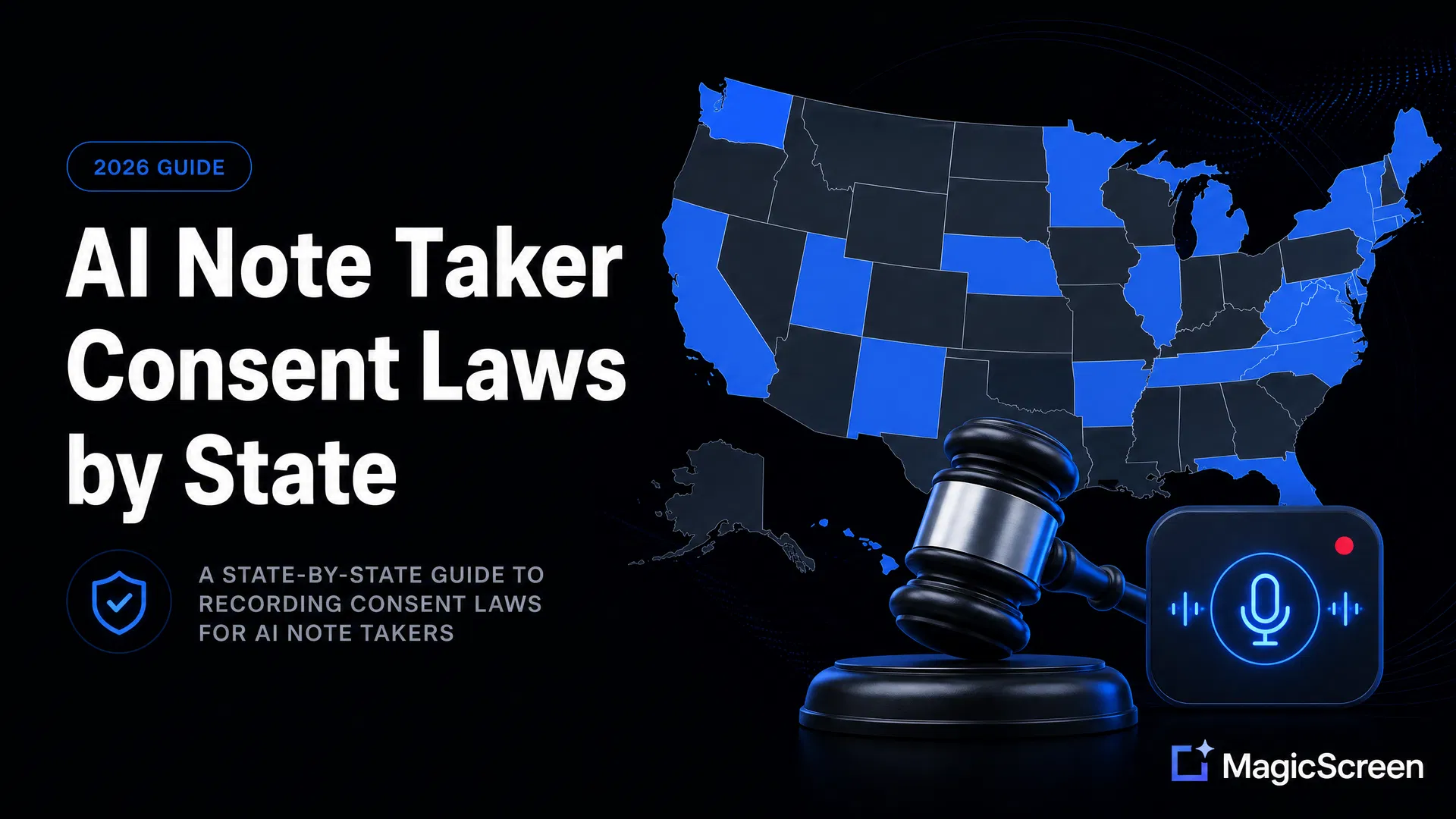
You’re evaluating ai note taker consent laws by state so you can run meetings, coach reps, and capture notes without triggering criminal wiretapping statutes or surprising prospects. This guide lays out the difference between one-party and all-party (commonly called two-party consent) rules, calls out the states most often treated as all-party consent, and gives a practical compliance checklist you can implement today.
Legal disclaimer: This is reference material, not legal advice. Laws change and are interpreted by courts. Confirm requirements with counsel or official state resources before relying on this guide for high-risk use cases.
AI Note Taker Consent Laws by State: quick primer on recording consent laws
At a high level, federal law allows audio recording so long as at least one participant in the conversation consents. State laws vary: most states follow one-party consent, while a subset require all-party consent. Whether an ai note taker is treated as a "recording" or a "processing tool" may matter, but practically you should assume audio capture/transcription equals recording unless your tool expressly operates without transmitting or persisting audio.
When you ask “is it legal to record a sales call,” the short operational answer is: it depends on where the call (and participants) are located and whether every jurisdiction involved requires notice or consent. Because sales conversations often cross state lines, conservative compliance treats the strictest applicable law as controlling.
AI Note Taker Consent Laws by State: how one-party and all-party (two-party consent) differ
| Consent model | Who must consent | Practical effect for sales calls and AI note takers |
|---|---|---|
| One-party consent | At least one participant (typically you or your rep) | You can record with your own consent, but consider notice best practice for cross-state calls and customer trust. |
| All-party consent (commonly "two-party consent") | Every participant | You must obtain express consent from the other side before recording/transcribing. Silent or hidden capture risks criminal or civil exposure. |
AI Note Taker Consent Laws by State: commonly cited all-party (two-party) consent states
Research and commonly cited legal summaries identify the following states as requiring all-party consent for audio recordings. Call these out explicitly when you design consent flows:
- California
- Connecticut
- Florida
- Illinois
- Maryland
- Massachusetts
- Michigan
- Montana
- Nevada
- New Hampshire
- Pennsylvania
These states are commonly listed in legal resources as requiring consent of all parties to a conversation before recording. Because statutes and interpretations evolve, verify the current status with counsel and official state resources when your call participants include any of these jurisdictions.
AI Note Taker Consent Laws by State: practical rules for distributed sales teams
You need a policy you can operationalize across reps, territories, and platforms. Below is a prioritized checklist you can implement immediately to reduce legal risk and win trust.
- Default to notice and consent — Verbally announce recording/transcription at the start of every call and require explicit agreement. This covers nearly all risk profiles and is simple to teach reps.
- Include consent language in calendar invites — Add a one-line disclosure to meeting invites (e.g., “This meeting may be transcribed or summarized using an AI note taker. Reply ‘I consent’ to attend if you accept.”).
- Configure platform settings — Some conferencing platforms require host permission for third-party overlays or transcription. Ensure meeting hosts enable required permissions and that your ai note taker respects platform controls.
- Use affirmative opt-in for external participants — For cold outreach, public webinars, or multi-party meetings, capture written consent (email reply, form checkbox) when feasible.
- Respect cross-border complexity — If participants are in multiple states (or countries), apply the strictest applicable law and get consent from all parties when any participant is in an all-party state.
- Audit storage and access — Know whether notes, transcripts, or audio are persisted, who can access them, and how long they’re retained. Minimizing persistence reduces exposure.
- Train your reps — Make a short script and role-play common scenarios: a prospect refusing consent, joining mid-call, or an outbound demo where the prospect says nothing when asked.
- Document your process — Keep a log that consent was requested and either granted or refused for each recording/transcription session.
Sample one-line consent scripts you can use
- Verbally at start of call: “We use an AI note taker for accuracy. Do you consent to a live transcript and summary?”
- On a dial-in or voice-only call: “If you do not consent, we will not record this call — please say ‘I consent’ to continue.”
- In written materials: “By participating, you acknowledge this meeting may be transcribed for coaching and notes.”
Is it legal to record a sales call? Common compliance traps and how to avoid them
When people ask “is it legal to record a sales call,” the traps are predictable:
- Assuming federal law covers you: Federal one-party consent doesn’t override stricter state statutes.
- Hidden capture: Recording or using a transcription tool without any participant notice, especially in all-party states, creates legal risk and harms trust.
- Multiple jurisdictions: Cross-state calls may pull multiple laws into play; conservative approach is all-party notice/consent.
- Product marketing vs. reality: Some AI note takers claim “no recording” but still process audio. Validate the technical architecture and data flows.
To avoid these traps, require consent by default, verify how your chosen tool handles audio, and keep retention and access controls strict.
Operational decision table: should you enable live AI notes for a call?
| Situation | Action | Why |
|---|---|---|
| All participants in one-party consent state(s) | Optional: enable with rep consent and best-practice notice | Legal risk lower, but trust and privacy expectations still apply |
| Any participant in an all-party (two-party) consent state | Require explicit consent from every participant before enabling | Statutes in those states commonly require consent of all parties |
| Cross-state or international call | Default to getting consent from every attendee | Applies the strictest relevant requirement and minimizes enforcement risk |
| Prospect refuses consent | Do not enable AI recording/transcription; offer manual note-taking or reschedule | Respecting refusal avoids legal and reputational harm |
What to do if you rely on an AI overlay that claims not to record
Some AI note takers (including overlays that don’t join the meeting) say they don’t “record.” You still need to verify three things before assuming you’re clear:
- Does the tool capture raw audio in memory or stream it to a service?
- Is any transcription or summary stored, logged, or shared?
- Are you confident the technical design avoids “interception” under state wiretapping statutes?
If technical documentation leaves doubt, require affirmative consent or seek a written vendor attestation describing how audio is handled and how it complies with wiretapping laws.
Final checklist: practical next steps for sales and ops teams
- Create a one-sentence consent disclosure for use in calendar invites and opening lines.
- Train reps to ask for explicit verbal consent and how to respond to refusal.
- Document consent when captured (log or CRM field).
- Audit your AI note taker vendor’s architecture and retention policies.
- When in doubt, don’t enable live capture; use manual notes or a recorded summary after getting written consent.
Following a consistent, conservative policy protects you legally and builds trust with prospects. Research suggests transparency improves meeting engagement and conversion — and frankly, it avoids headaches you don’t want.
Need a tool that aligns with this approach? MagicScreen runs natively on Mac as an invisible overlay and is designed to work without joining the meeting or persisting recordings (verify current product details with our documentation). Start with clear verbal notice and enable only when you have consent.
Ready to try a compliant, low-friction approach to live coaching and note-taking? Download MagicScreen to get started: /download